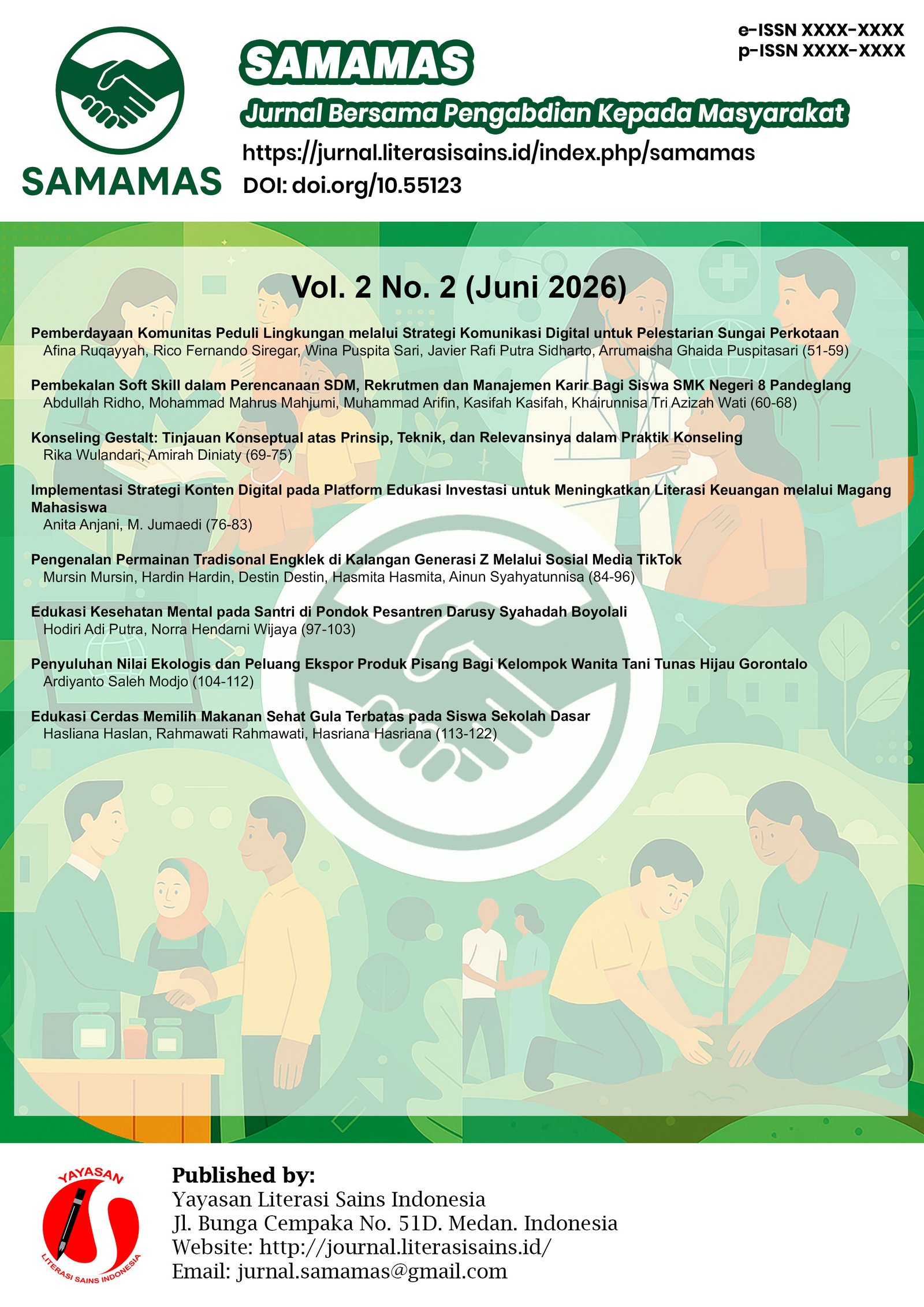
Edukasi Cerdas Memilih Makanan Sehat Gula Terbatas pada Siswa Sekolah Dasar
DOI:
https://doi.org/10.55123/samamas.v2i2.1015Keywords:
Education, Sugar Consumption, School Age ChildrenAbstract
People of all ages, from children to adults, enjoy sweet foods. However, Indonesia is witnessing a concerning trend regarding the consumption of added sugars. Excessive sugar intake at an early age can have long-term health consequences, including risks of obesity, diabetes, and tooth decay. Elementary school-aged children are particularly vulnerable to exposure to high-sugar foods and beverages, especially through school snacks. This community service initiative aimed to educate students on the importance of limiting sugar intake and to guide them in making healthy daily food choices. The activity took place on December 19, 2025, at SDN Inpres 5/81 Passippo in Passippo Village, Palakka District, Bone Regency, with 38 students participating. The program utilized interactive education, a simulation on selecting healthy snacks, and an evaluation component. The results indicated that most students gained a better understanding of low-sugar, healthy foods and began limiting their sugar intake by avoiding products with excessive sugar. Nevertheless, some students continued to consume high-sugar foods and beverages, highlighting the need for a sustained approach that involves both teachers and parents.
Downloads
References
Adina. A.B, A. Z. (2024). Program Edukasi “Bahaya Makanan Tinggi Gula” bagi Siswa SDN 1 Kalibaru: Dampak terhadap Pemahaman Gizi. Jurnal ANDARA, 1-5.
Aulia.JN. (2022). MASALAH GIZI PADA ANAK USIA SEKOLAH. Jurnal Ilmiah Media Husada, 21-27.
Dian. .F.A, M. ,. (2022). PRINSIP DASAR ILMU GIZI. Bandung: Media Sains Indonesia.
Februhartanty. J, S. (2021). Gizi dan Kesehatan Anak Sekolah di Indonesia. Jakarta: SEAMEO RECFON.
Kurniawan.D, S. d. (2021). Konsumsi Jajanan Sekolah dan Hubungannya dengan Status Gizi Anak Sekolah Dasar di Daerah Perkotaan dan Pedesaan. Jurnal Gizi INdonesia, 45-53.
Mudayanah. (2025). Bahaya gula bagi anak-anak: Mengapa orang tua harus. Maliki Interdisciplinary Journal, 1117-1124.
Nabila. D.S, H. B. (2025). Pengaruh Edukasi Pendidikan Gizi Terhadap Perilaku Anak Sekolah Kelas V di SDS IT Al Wahdah Kendari Tahun 2024. Jurnal Anestesi, 29-39.
RI, K. K. (2018). Laporan Nasional Riset Kesehatan Daerah. Jakarta: Badan Penelitian dan Pnegembangan Kesehatan.
Suryanto. H, d. S. (2021). Pengaruh Edukasi Gizi Terhadap Pengetahuan Gizi Seimbang Pada Anak Sekolah. Wijayakusuma National Conference (pp. 133-138). Cilacap: WiNCo.
Kementerian Kesehatan Republik Indonesia. (2020). Isi Piringku: Panduan gizi seimbang untuk anak usia sekolah (6–12 tahun). Direktorat Gizi, Direktorat Jenderal Kesehatan Masyarakat
Kementerian Kesehatan RI. (2013). Peraturan Menteri Kesehatan Republik Indonesia Nomor 30 Tahun 2013 tentang Pencantuman Informasi Kandungan Gula, Garam, dan Lemak serta Pesan Kesehatan untuk Pangan Olahan dan Pangan Siap Saji. Kementerian Kesehatan RI.
Kementerian Kesehatan RI. (2023). Survei Kesehatan Indonesia (SKI) dalam angka. Badan Kebijakan Pembangunan Kesehatan.
Marfi, W. O. E., Majid, R., & Akib, N. (2026). Pengaruh edukasi kesehatan dengan media video dan leaflet terhadap peningkatan pengetahuan, sikap, dan tindakan tentang bahaya konsumsi minuman manis. Jurnal Kesehatan Tropis Indonesia, 4(3), 548–567. https://doi.org/10.63265/jkti.v4i3.241
Rahmani, A. D., Musrizal, F. N., Ayu, R., Olivia, S., & Rusdiana, N. (2025). Sosialisasi dan tingkat pengetahuan tentang bahaya minuman manis dan berwarna kepada siswa kelas 5A SDIP Insan Robbani. Jurnal Pengabdian Kolaborasi dan Inovasi IPTEKS, 3(3), 792–802. https://doi.org/10.59407/jpki2.v3i3.2670
Sinaga, J., Sinambela, J. L., Purba, B. C., & Pelawi, S. (2024). Gula dan kesehatan: Kajian terhadap dampak kesehatan akibat konsumsi gula berlebih. Jurnal Ilmiah Multidisiplin Indonesia, 2(1), 54–68.
World Health Organization. (2015, March 4). WHO calls on countries to reduce sugars intake among adults and children. https://www.who.int/news/item/04-03-2015-who-calls-on-countries-to-reduce-sugars-intake-among-adults-and-children
Golan, M., Tamir, A., & Madjar, O. (2019). The role of the family in the development of eating habits and childhood obesity. *Pediatric Endocrinology Reviews*, 16(4), 450-457.
Kelly, B., Freeman, B., & Chapman, S. (2015). New media and food marketing to children: The role of digital platforms. *Public Health Nutrition*, 18(12), 2135-2142. https://doi.org/10.1017/S1368980014002851
Lustig, R. H. (2013). Fructose: It's "Alcohol Without the Liquor". *Current Opinion in Clinical Nutrition and Metabolic Care*, 16(4), 414-420. https://doi.org/10.1097/MCO.0b013e328361d421
Downloads
Published
How to Cite
Issue
Section
License
Copyright (c) 2026 Hasliana Haslan, Rahmawati, Hasriana

This work is licensed under a Creative Commons Attribution-ShareAlike 4.0 International License.
Authors who publish with this journal agree to the following terms:
- Authors retain copyright and grant the journal right of first publication with the work simultaneously licensed under Creative Commons Attribution-ShareAlike 4.0 International License that allows others to share the work with an acknowledgment of the work's authorship and initial publication in this journal.
- Authors are able to enter into separate, additional contractual arrangements for the non-exclusive distribution of the journal's published version of the work (e.g., post it to an institutional repository or publish it in a book), with an acknowledgment of its initial publication in this journal.
- Authors are permitted and encouraged to post their work online (e.g., in institutional repositories or on their website) prior to and during the submission process, as it can lead to productive exchanges, as well as earlier and greater citation of published work (Refer to The Effect of Open Access).