Konseling Gestalt: Tinjauan Konseptual atas Prinsip, Teknik, dan Relevansinya dalam Praktik Konseling
DOI:
https://doi.org/10.55123/samamas.v2i2.782Keywords:
Gestalt Counseling, Inmates, Self-Awareness, Emotional Regulation, Community ServiceAbstract
The mental health inmates is an issue that is often overlooked within Indonesia's correctional system. This group faces layered psychological pressures, including loss of freedom, social stigma, severed family relationships, and anxiety about social acceptance after release. This community service activity aims to provide counseling services based on the Gestalt approach to inmates at a correctional institution (Lapas) in Pekanbaru, Riau., as a concrete effort to support mental health, strengthen self-awareness, and build emotional regulation capacity. The activity was conducted on June 5, 2026, involving 19 participants, using a three-stage method: administration, psychoeducation, and individual one-on-one counseling sessions between student counselors and inmates. Results indicate that the Gestalt approach effectively facilitated participants' self-awareness of previously unprocessed emotional experiences, encouraged re-authoring of life narratives from stigma toward dignified acceptance, and identified internal strengths rooted in family support and spirituality as foundations of resilience. These findings affirm the relevance of Gestalt counseling as a responsive and dignified psychological intervention for incarcerated populations, while opening space for the development of similar programs on a sustained basis within Indonesian correctional settings.
Downloads
References
Brownell, P. (2016). Gestalt therapy for addictive and self-medicating behaviors. Springer Publishing Company.
Cannavò, M., Davì, D., & Cervellione, B. (2026). Gestalt therapy and somatic symptom disorder: Clinical reflections on embodiment, contact, and relational field. The Journal of Humanistic Counseling, 65(S1), S58–S66. https://doi.org/10.1002/johc.70025
Corey, G. (2021). Theory and practice of counseling and psychotherapy (10th ed.). Cengage Learning.
Crocker, S. (2019). A unified theory BT - Handbook for theory, research, and practice in Gestalt therapy (P. Brownell (ed.); 2nd ed., pp. 157–182). Cambridge Scholars Publishing.
Favril, L., Rich, J. D., Hard, J., & Fazel, S. (2024). Mental and physical health morbidity among people in prisons: An umbrella review. The Lancet Public Health, 9(4), e250–e260. https://doi.org/10.1016/S2468-2667(24)00023-9
Fisher, S., Fonagy, P., Wiseman, H., & Zilcha-Mano, S. (2023). “I see you as recognizing me; therefore, I trust you”: Operationalizing epistemic trust in psychotherapy. Psychotherapy, 60(4), 560–572. https://doi.org/10.1037/pst0000501
Jacobs, L. (2019). Relationality and relational process in Gestalt therapy BT - Handbook for theory, research, and practice in Gestalt therapy (P. Brownell (ed.); 2nd ed., pp. 203–219). Cambridge Scholars Publishing.
Joyce, P., & Sills, C. (2018). Skills in Gestalt counselling & psychotherapy (4th ed.). SAGE Publications.
Kaisler, R. E., Fede, M., Diltsch, U., Probst, T., & Schaffler, Y. (2023). Common mental disorders in Gestalt therapy treatment: A multiple case study comparing patients with moderate and low integrated personality structures. Frontiers in Psychology, 14, 1304726. https://doi.org/10.3389/fpsyg.2023.1304726
Mann, D. (2021). Gestalt therapy: 100 key points and techniques (2nd ed.). Routledge.
Martínez-Priego, C., Poveda García-Noblejas, B., & Roca, P. (2024). Strategies and goals in Emotion Regulation models: A systematic review. Frontiers in Psychology, 15, 1425465. https://doi.org/10.3389/fpsyg.2024.1425465
Philippson, P. (2019). The implications of scientific findings BT - Handbook for theory, research, and practice in Gestalt therapy (P. Brownell (ed.); 2nd ed., pp. 356–364). Cambridge Scholars Publishing.
Riskesdas. (2018). Laporan nasional Riset Kesehatan Dasar (Riskesdas) 2018. Kementerian Kesehatan Republik Indonesia.
Steindl, S. R., Matos, M., & Dimaggio, G. (2023). The interplay between therapeutic relationship and therapeutic technique: The whole is more than the sum of its parts. Journal of Clinical Psychology, 79(7), 1686–1692. https://doi.org/10.1002/jclp.23519
WHO. (2022). World mental health report: Transforming mental health for all. World Health Organization.
Yontef, G., & Jacobs, L. (2019). Gestalt therapy BT - Current psychotherapies (D. Wedding & R. J. Corsini (eds.); 11th ed., pp. 287–328). Cengage Learning.
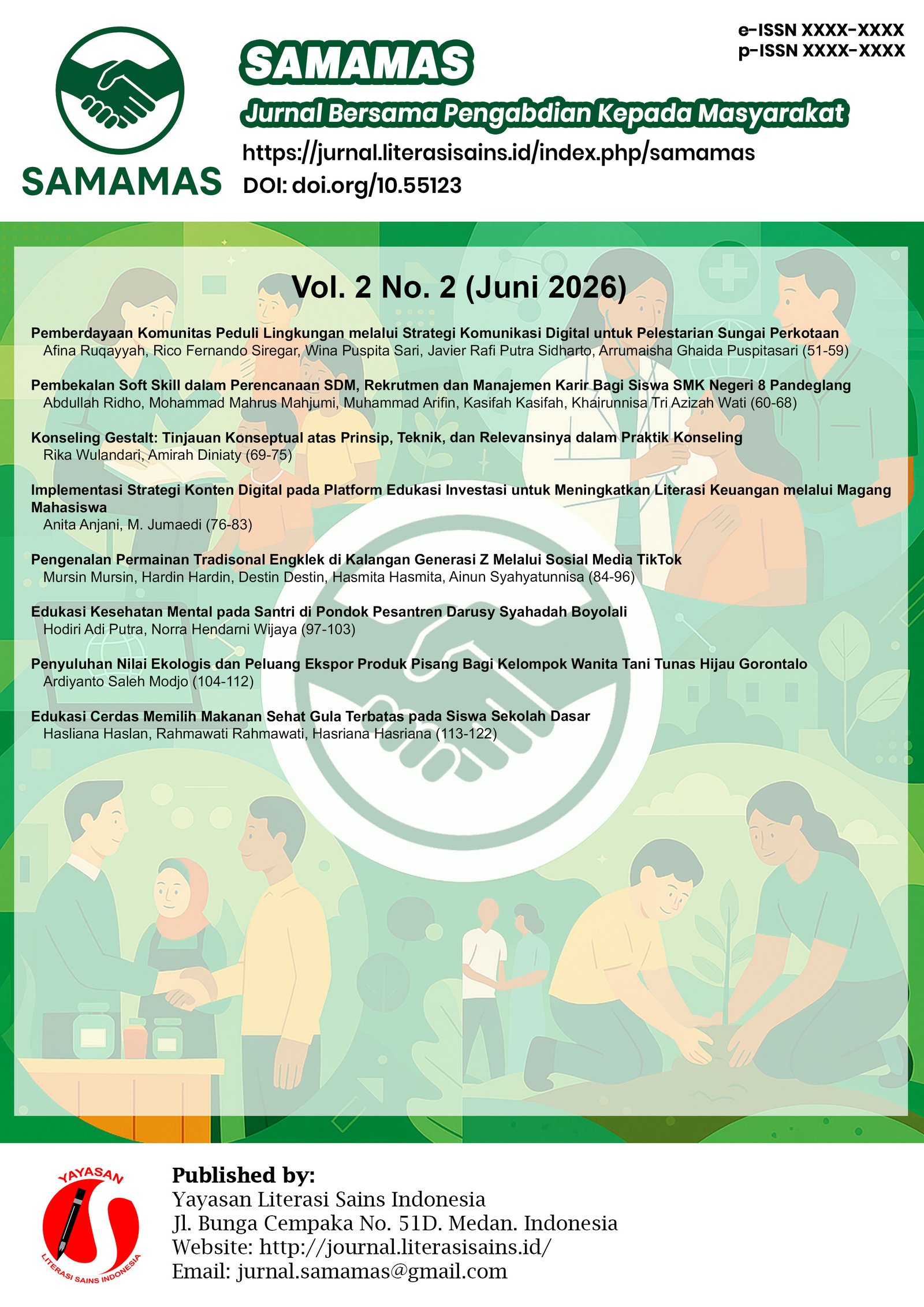
Downloads
Published
How to Cite
Issue
Section
License
Copyright (c) 2026 Rika Wulandari, Amirah Diniaty

This work is licensed under a Creative Commons Attribution-ShareAlike 4.0 International License.
Authors who publish with this journal agree to the following terms:
- Authors retain copyright and grant the journal right of first publication with the work simultaneously licensed under Creative Commons Attribution-ShareAlike 4.0 International License that allows others to share the work with an acknowledgment of the work's authorship and initial publication in this journal.
- Authors are able to enter into separate, additional contractual arrangements for the non-exclusive distribution of the journal's published version of the work (e.g., post it to an institutional repository or publish it in a book), with an acknowledgment of its initial publication in this journal.
- Authors are permitted and encouraged to post their work online (e.g., in institutional repositories or on their website) prior to and during the submission process, as it can lead to productive exchanges, as well as earlier and greater citation of published work (Refer to The Effect of Open Access).