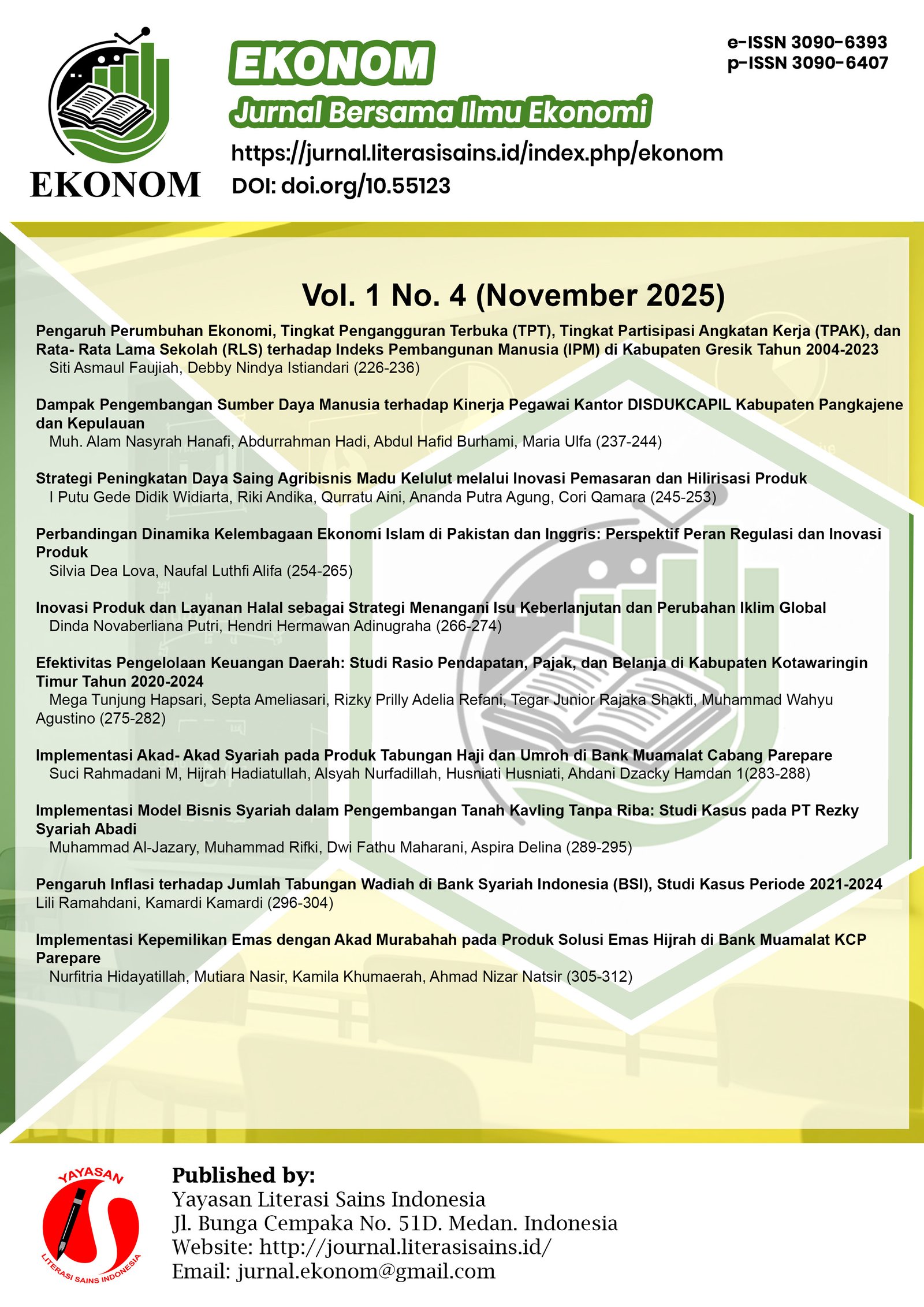
Pengaruh Perumbuhan Ekonomi, Tingkat Pengangguran Terbuka (TPT), Tingkat Partisipasi Angkatan Kerja (TPAK), dan Rata- Rata Lama Sekolah (RLS) terhadap Indeks Pembangunan Manusia (IPM) di Kabupaten Gresik Tahun 2004-2023
DOI:
https://doi.org/10.55123/ekonom.v1i4.297Keywords:
Economic Growth, Open Unemployment Rate, Labor Force Participation Rate, Average Years of Schooling, Human Development IndexAbstract
This study aims to analyze the influence of economic growth, the open unemployment rate, the labor force participation rate, and the average years of schooling on the Human Development Index in Gresik Regency from 2004 to 2023. Secondary data obtained from the Central Statistics Agency (BPS) were analyzed using multiple linear regression with SPSS. The results indicate that, partially, the average years of schooling and the labor force participation rate have a positive and significant effect on the Human Development Index. In contrast, economic growth and the open unemployment rate do not show a significant effect. However, simultaneously, all four independent variables significantly influence the Human Development Index. This indicates the importance of investing in education and increasing productive labor force participation in sustainable human development efforts. Based on this, it is recommended that the Gresik Regency government prioritize policies that support improving the quality of education, job training, and creating quality jobs. Furthermore, cross-sector collaboration is needed to ensure that economic growth directly impacts community welfare by reducing unemployment and increasing human resource capacity.
Downloads
References
Ardian, R., Yulmardi, Y., & Bhakti, A. (2021). Pengaruh Pertumbuhan Ekonomi, Indeks Pembangunan Manusia, dan Tingkat Pengangguran Terbuka terhadap Tingkat Kemiskinan di Provinsi Jambi. Jurnal Ekonomi Aktual, 1(1), 23–34. https://doi.org/10.53867/jea.v1i1.3
Ariesti, A. E., & Asmara, K. (2023). Analisis Faktor-Faktor yang Mempengaruhi Tingkat Partisipasi Angkatan Kerja (TPAK) di Pulau Jawa. Economics and Digital Business Review, 4(2), 432–438.
BPS. (n.d.). Indikator Pasar Tenaga Kerja Indonesia Februari 2024. 2024. Retrieved September 12, 2024, from https://www.bps.go.id/id/publication/2024/06/14/574e2f9c7d3397fbd175423 4/indikator-pasar-tenaga-kerja-indonesia-februari-2024.html
BPS. (2023a). BPS. Https://Gresikkab.Bps.Go.Id/Id/Statistics-Table/2/MzAjMg%253D%253D/Pdrb-Kabupaten-Gresik-Atas-Dasar-Harga-Berlaku-Menurut-Lapangan-Usaha.Html.
BPS. (2023b). Indeks Pembangunan Manusia (IPM) Kabupaten Gresik 2023. BPS. https://gresikkab.bps.go.id/id/pressrelease/2023/12/03/222/indeks- pembangunan-manusia--ipm--kabupaten-gresik-2023.html
BPS. (2023c). Rata-Rata Lama Sekolah. BPS Jatim. BPS. (2024a). BPS KAB. GRESIK. 2024.
BPS. (2024b). luas wilayah menurut tanah.
Caron, J., & Markusen, J. R. (2016). Pengaruh Jumlah Penduduk, Upah Minimum, Pertumbuhan Ekonomi Dan Tingkat Pendidikan Terhadap Tingkat Pengangguran Terbuka di Kabupaten Gresik. 8, 1–23.
FIKRI, Y. T. A. (2020). Teori Pengangguran, Struktur Pola dan Penyediaan Lapangan Kerja, Rigrisitas Standarisasi Upah dan Jaminan Sosial. Jurnal Ekonomi, Juli, 1–23.
Junaidi, A., Wibowo, M. G., & Hasni. (2021). Analisis Pengaruh Makro Ekonomi terhadap Indeks Harga Saham Syariah Indonesia. Jurnal Ekonomi dan Bisnis, Vol. 24(01), 17–29.
kominfo. (2022). Gresikkab.go.id. https://gresikkab.go.id/detail_news/melalui-pendidikan-vokasi-diharapkan-menjadi-solusi-peningkatan-kualitas-sdm-dan-menekan-angka pengangguran
kominfo. (2024). Tekan angka kemiskinan: Wabup Gresik Buka Pelatihan Usaha untuk Pemberdayaan Ekonomi Program Bunda Puspa Tahun 2024. Situs Resmi Pemerintah Kabupaten Gresik. https://gresikkab.go.id/detail_news/tekan-angka-kemiskinan-wabup-gresik-buka-pelatihan-usaha-untuk-pemberdayaan-ekonomi-program-bundapuspatahun2024#:~:text= Tekan angka kemiskinan: Wabup Gresik,Program Bunda Puspa Tahun 2024
Manurung, E. N., & Hutabarat, F. (2021). Pengaruh Angka Harapan Lama Sekolah, Rata-Rata Lama Sekolah, Pengeluaran Per Kapita terhadap Indeks Pembangunan Manusia. Jurnal Ilmiah Akuntansi Manajemen, 4(2), 121–129. https://doi.org/10.35326/jiam.v4i2.1718
Muslihatinningsih, F., Alvidiar, C., & Niken Wilantari, R. (2023). Does Government Spending Affect Human Development Index in East Java Province. Jae (Jurnal Akuntansi Dan Ekonomi), 8(1), 138–149. https://doi.org/10.29407/jae.v8i1.19806
Nastiti, A. W., & Nailufar, F. (2024). Pengaruh Angka Partisipasi Sekolah (APS) dan Tingkat Partisipasi Angkatan Kerja (TPAK) terhadap Indeks Pembangunan Manusia (IPM) di Indonesia. Jurnal Ekonomi Regional Unimal, 6(3), 1. https://doi.org/10.29103/jeru.v6i3.15178
Purboningtyas, I., Sari, R., Guretno, T., Dirgantara, A., Dwi, A., & Al Haris, M. (2020). Analisis Pengaruh Tingkat Pengangguran Terbuka dan Indeks Pembangunan Manusia terhadap Kemiskinan di Provinsi Jawa Tengah Analysis of The Influence of Open Unemployment Levels and Human Development Index on Poverty in Central Java Province. Jurnal Sains Dan Matematika Unpam, 3(1), 81–88. https://core.ac.uk/download/pdf/337609876.pdf
Purwanda, E. (2022). The Influence of the Human and Economic Index Development Components on the Unemployment Rate in Indonesia. Ijd- Demos, 4(2), 761–772. https://doi.org/10.37950/ijd.v4i2.264
Schumpeter, J. A., & Swedberg, R. (2021). The Theory of Economic Development. Routledge.
Tahir, M., Jahrir, A. S., Patak, A. A., Jafar, M. B., & Jabu, B. (2024). Pengenalan Analisis Data Statistik Deskriptif Kuantitatif dalam Penyelesaian Tugas Akhir pada Mahasiswa Pendidikan Bahasa Inggris Universitas Muslim Maros. 5(4), 2363–2373.
Zainul Bahri, S. E., Aprilianti, D. R. V., SSTP, M. E., & Others. (2023). Menuju Kesejahteraan Berkelanjutan Pemahaman terhadap Pertumbuhan Ekonomi Klasik, Neoklasik, Islam, Green Economy, dan Blue Economy. Nas Media Pustaka.
Downloads
Published
How to Cite
Issue
Section
License
Copyright (c) 2025 Siti Asmaul Faujiah, Debby Nindya Istiandari

This work is licensed under a Creative Commons Attribution-ShareAlike 4.0 International License.
Hak cipta pada setiap artikel adalah milik penulis.
Penulis mengakui bahwa Jurnal Bersama Ilmu Ekonomi (EKONOM) sebagai publisher yang mempublikasikan pertama kali dengan lisensi Creative Commons Attribution-ShareAlike 4.0 International License.
Penulis dapat memasukan tulisan secara terpisah, mengatur distribusi non-ekskulif dari naskah yang telah terbit di jurnal ini kedalam versi yang lain, seperti: dikirim ke respository institusi penulis, publikasi kedalam buku, dan lain-lain. Dengan mengakui bahwa naskah telah terbit pertama kali pada Jurnal Bersama Ilmu Ekonomi (EKONOM).